Selecting a fire hose isn't just a procurement task; it’s a safety-critical decision. Whether you are an industrial safety officer, a construction contractor, or a municipal distributor, understanding the technical nuances of fire hoses can prevent catastrophic failures and save long-term costs.
In this guide, we break down the essential standards and material science of fire hoses, mirroring the rigorous safety logic we apply to all our industrial hose solutions at Sinohose.
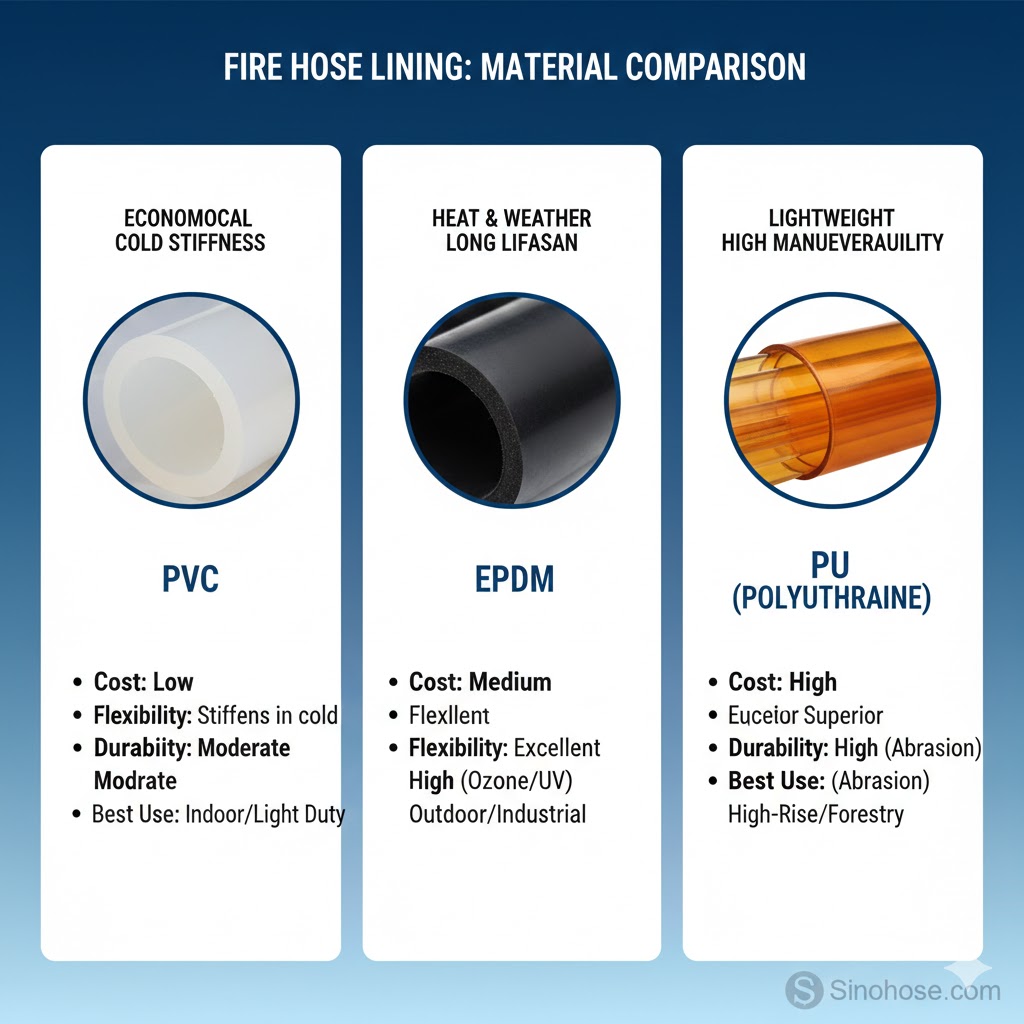
The internal lining determines the hose's weight, flexibility, and chemical resistance. Choosing the wrong lining is the #1 cause of premature hose degradation.
PVC Lining: The most cost-effective solution. Ideal for indoor fire cabinets in residential buildings. However, it can become stiff in extremely cold climates.
EPDM Rubber Lining: The "all-rounder." It offers excellent resistance to heat, ozone, and weathering. Perfect for outdoor hydrants and industrial plants.
PU (Polyurethane) Lining: The modern gold standard. It is incredibly lightweight and thin, making it the top choice for high-rise building firefighting where maneuverability is key.
Nitrile Rubber (NBR) Lining: Essential for oil and gas environments or chemical docks where fuel or oil contact is likely.
Just like our popular guide on Gas Hose Lengths, safety in fire hoses is defined by precise numbers. Many low-cost suppliers highlight the "Test Pressure" to make the hose seem stronger than it is.
Working Pressure (WP): The maximum pressure the hose is designed to handle during routine operation (typically 8–20 Bar).
Test Pressure (TP): Usually 1.5x the WP. This is the pressure used during annual safety inspections.
Burst Pressure (BP): According to international standards like EN14540 or UL19, the BP must be at least 3x the Working Pressure.
Pro Tip: Always ask for a Burst Pressure Test Report. A hose with a high WP but a low safety margin (BP) is a "ticking time bomb" under hydraulic shock.
The outer "jacket" protects the hose from abrasion and sharp objects.
Single Jacket: Lightweight and easy to fold. Best for indoor stationary use.
Double Jacket: Features a second tightly woven layer. It is mandatory for municipal fire departments and heavy-duty construction sites where the hose is frequently dragged across concrete or debris.
Customers often ask, "Can I have a 100-meter fire hose?" While customization is possible, the industry standard is 15m, 20m, or 30m.Why? 1. Pressure Drop: The longer the hose, the more friction loss occurs, significantly reducing the water reach at the nozzle. 2. Weight & Handling: A water-filled 30m hose is already heavy; any longer, and it becomes nearly impossible for a single firefighter to maneuver effectively.
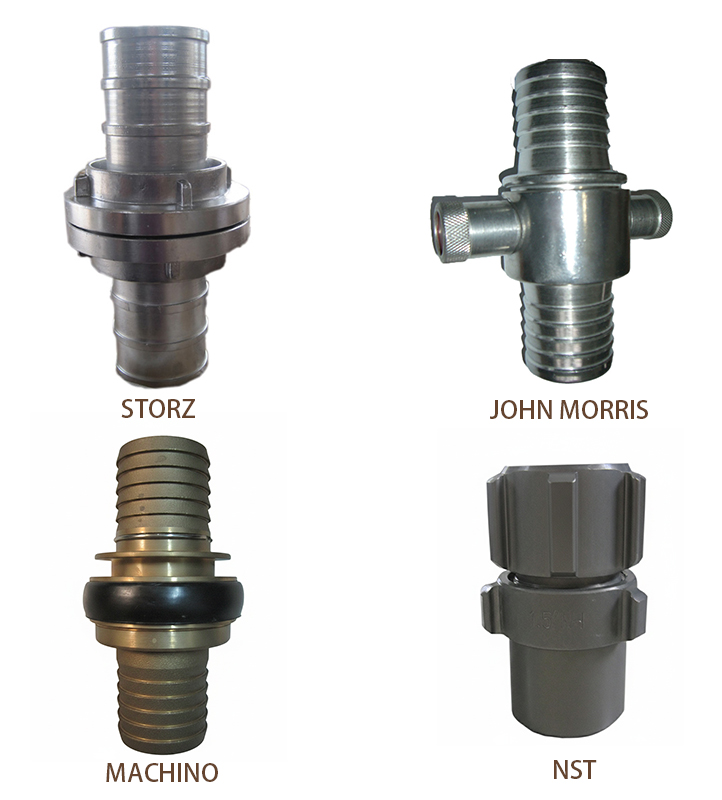
A world-class fire hose is useless if it doesn't click into the local hydrant. At Sinohose, we supply pre-fitted hoses with internationally recognized couplings:
Storz (Germany/Europe)
John Morris/Inst. (UK)
NH/NST (USA)
Machino/Nakajima (Japan/Asia)
We use high-strength aluminum or brass alloys and high-pressure binding technology to ensure the coupling never separates from the hose under peak pressure.
Buying a "cheap" fire hose often leads to cracking, leaking, or failing inspection within 12 months. Investing in a high-quality, certified hose from a reputable manufacturer like Sinohose ensures a service life of 5–10 years with proper maintenance.
How often should I test my fire hose?
We recommend a hydrostatic test once a year.
What is the shelf life?
Even if unused, rubber-lined hoses should be replaced every 10 years to ensure lining integrity.
Whether you need high-visibility PU hoses or heavy-duty EPDM industrial fire hoses, our technical team is ready to assist.
[Contact Sinohose for a Professional Consultation Today]