In heavy-duty applications such as mine dewatering, oilfield water transfer, and large-scale agricultural irrigation, PVC Nitrile layflat hoses are favored for their high working pressure, chemical resistance, and excellent flexibility. However, even the highest-grade Nitrile-blended discharge hose can suffer from premature failure, fitting blow-offs, or pinhole leaks if installed incorrectly.
Proper installation not only extends the operational lifespan of your liquid transfer system but also protects workers from high-pressure line bursts. Below is a comprehensive engineering guide on installing and connecting PVC Nitrile layflat hoses correctly.
Before uncoiling the hose on-site, a quick inspection prevents costly downtime:
Inspect the Layline Specifications: Verify that the inner diameter (ID), working pressure (WP), and chemical compatibility (e.g., fuel, oil, or dirty slurry) match your system’s pump specs.
Clear the Terrain: While Nitrile rubber offers superior abrasion resistance compared to standard PVC, dragging a pressurized hose over jagged rocks, steel scrap, or sharp tree stumps should be minimized.
Check Ambient Temperature: Nitrile-PVC blends maintain flexibility down to -20°C (-4°F), but uncoiling in extremely frozen conditions should still be done gradually to avoid stress fractures on outer ribs.
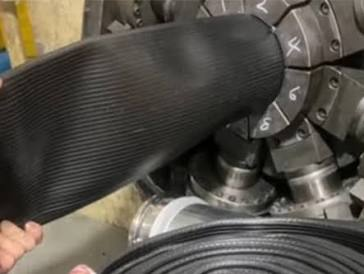
Assembling PVC nitrile layflat hose couplings.
Connecting a layflat hose securely requires the right coupling style based on your system pressure:
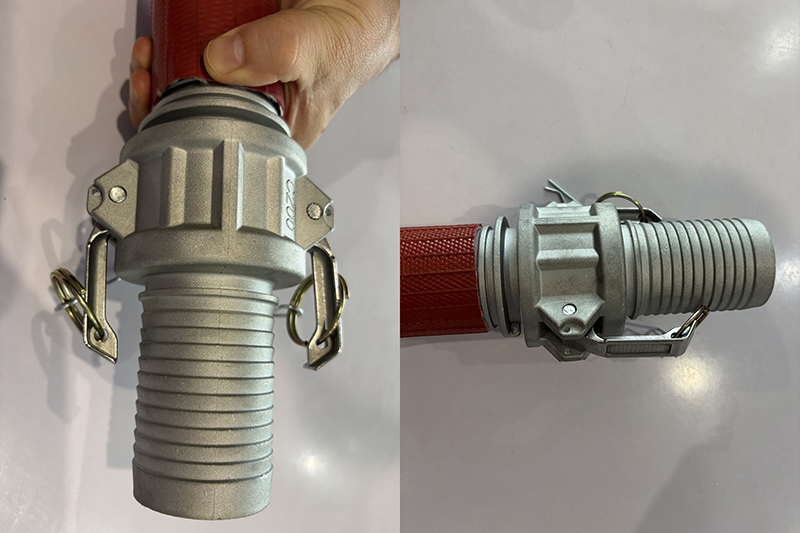
Camlock Couplings (Type C & E): Best for quick setup in medium-pressure water and mild chemical transfer.
Bauer-Type Quick Release Couplings: Ideal for agricultural slurry and mine dewatering where fast locking under muddy conditions is essential.
Flanged Ends (ANSI/DIN): Recommended for high-pressure, fixed oilfield or industrial installations.
Square Cut: Cut the hose end perpendicular to its length using a heavy-duty industrial hose cutter. A jagged or diagonal cut causes uneven clamping pressure.
Insert the Shank: Apply a light, non-degrading lubricant (such as soapy water) to the barbed coupling shank. Insert the shank fully into the hose inner tube until it reaches the collar.
Secure the Clamps:
For Standard Pressures: Use double-bolt heavy-duty segment clamps (Interlocking clamps).
For High Pressures: Utilize hydraulic swaging or crimping sleeves. Ensure clamps are placed behind the shank barbs to prevent coupling blow-off under pressure surges.
When laying out the hose line across the field or job site, follow these three core routing rules:
Never twist the hose along its longitudinal axis during deployment. Twisting a layflat hose restricts fluid flow and dramatically reduces burst pressure. Always unroll the hose straight using a reel or flat layout trailer.
Although Nitrile layflat hoses resist kinking better than PVC, forcing a 90-degree sharp turn will create localized pressure spikes. Use curved sweeping bends or 45/90-degree rigid elbows at direction changes.
Under full working pressure, Nitrile layflat hoses expand slightly in diameter and contract slightly in length (typically -1% to -3%). Do not pull the hose tight between fixed manifolds. Always leave a loose S-curve or slack loop near connections to absorb pressure surges and pump vibrations.
Slow Priming: Open valves gradually and allow air to bleed out of the system at the highest elevation point before bringing the pump to full operating pressure. Rapid air compression can trigger a shockwave (water hammer) that damages hose walls.
Pressure Check: Operate at 50% pressure for 5 minutes, checking for seepage around clamps or shank collars.
Torque Retightening: After 1 hour of initial operation under temperature and pressure, re-check bolt torques on segment clamps, as rubber compression can lead to minor clamp loosening.
Never run heavy tracked vehicles over a pressurized hose without protective hose ramps.
Drain completely after pumping chemical or hydrocarbon fluids before rolling up for storage.
Store on reels away from direct weather exposure and strong oxidizing agents.
For industrial-grade PVC Nitrile layflat hoses engineered for severe mining and agricultural duty, contact our engineering team at Sinohose Technical Support for custom length and coupling configurations.