When sourcing flexible discharge pipelines for fluid transfer, selecting the wrong hose material can lead to frequent line replacements, environmental leaks, and unexpected site downtime. Two of the most common options in the market are Standard PVC Layflat Hoses (often blue, green, or brown) and PVC Nitrile Layflat Hoses (typically black, yellow, or red ribbed).
While both styles roll flat for compact storage and easy deployment, their material formulations and physical durability differ significantly. This guide delivers a direct engineering comparison between PVC Nitrile and standard PVC layflat hoses to help you make an informed purchasing decision.
The primary difference lies in the polymer compound fused around the internal high-tensile polyester weave:
Standard PVC Layflat Hose: Made from plasticized Polyvinyl Chloride. It is lightweight, flexible under moderate temperatures, and economical for straightforward water discharge.
PVC Nitrile Layflat Hose: Features a synthetic blend of Nitrile Rubber (NBR) and PVC, produced through a single-pass "through-the-weave" extrusion process. The addition of Nitrile endows the hose with rubber-like elastomeric properties, high oil resistance, and superior toughness.
Standard PVC: Suitable for grass, smooth soil, or paved agricultural tracks. Continuous dragging across sharp granite, crushed rock, or industrial slag will quickly wear down the outer PVC cover, exposing the reinforcement yarns to moisture and rotting.
PVC Nitrile: Designed with heavy exterior longitudinal ribs. The NBR rubber formulation delivers exceptional resistance to gouging, dragging, and impact. It thrives on harsh mining terrains, construction sites, and oilfield pads.
Standard PVC: Performs well with clean water, light liquid fertilizers, and neutral agricultural runoff. However, exposure to diesel, crude oil, hydraulic fluids, or strong solvents softens and degrades standard PVC rapidly.
PVC Nitrile: Nitrile (NBR) is inherently oil-resistant. PVC Nitrile layflat hoses handle oily water, hydrocarbons, fuels, industrial wastewater, and mild chemicals without swelling, delaminating, or cracking.
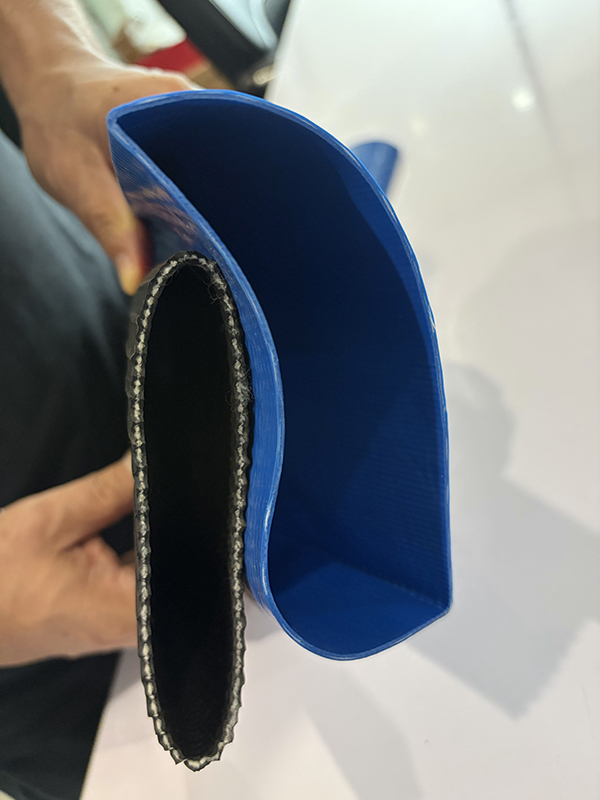
Standard PVC: Highly sensitive to ambient temperatures. In cold weather (below 0°C / 32°F), standard PVC becomes stiff, hard to roll, and susceptible to cold-cracking. In extreme heat, it softens, lowering its maximum working pressure.
PVC Nitrile: Maintains rubbery flexibility across a broad thermal envelope from -20°C to +80°C (-4°F to +176°F). It unrolls smoothly in sub-zero winter setups and retains structural pressure ratings under hot desert sun exposure.
Feature / Specification | Standard PVC Layflat Hose | PVC Nitrile Layflat Hose |
Primary Material | Plasticized PVC | Nitrile Rubber (NBR) + PVC Blend |
Typical Color | Blue, Green, Yellow | Black, Red, Dark Yellow (Ribbed) |
Abrasion Resistance | Moderate / Light-Duty | Extreme Heavy-Duty |
Oil & Fuel Resistance | Poor (Not recommended) | Excellent (Hydrocarbon-resistant) |
Temperature Range | -5°C to +60°C | -20°C to +80°C |
Working Pressure Range | Low to Medium (2 to 6 bar) | Medium to High (10 to 20+ bar) |
UV & Ozone Longevity | 1 - 3 Years (Outdoor) | 5+ Years (Heavy UV protection) |
Initial Purchase Cost | Low / Budget-friendly | Higher upfront investment |
While a PVC Nitrile layflat hose carries a higher initial purchase price than a basic blue PVC hose, evaluating the Total Cost of Ownership (TCO) reveals a different story for heavy industrial applications:
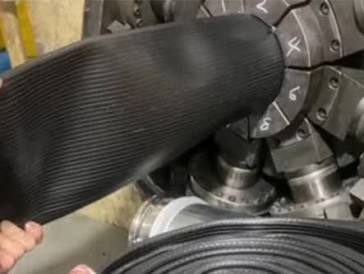
In a mining dewatering setup where a discharge line is dragged daily over rock face, a standard PVC hose may require replacement every 2–3 months due to punctures. A premium PVC Nitrile hose routinely lasts 3 to 5 times longer under identical conditions, eliminating repeated labor costs and project delays.
You are operating seasonal agricultural irrigation or garden drainage.
You are pumping clean water over non-abrasive terrain (grass, soil).
Project budget constraints prioritize low upfront capital expenditure.
You operate in mining, construction dewatering, oil & gas water transfer, or municipal flood relief.
The pumped fluid contains trace hydrocarbons, oils, or industrial chemicals.
You need a rugged, ribbed outer layer that withstands aggressive dragging over rock, gravel, and asphalt.
At Sinohose, we manufacture high-performance PVC Nitrile layflat hoses with customizable diameters (from 1" to 12"), pressure ratings, and factory-crimped coupling assemblies. Contact our sales team today to request factory-direct wholesale pricing and product datasheets.